There are two ways to waterproof a basement: from the inside or from the outside. Interior systems intercept water once it’s already near your foundation and redirect it away through a drain tile and sump pump. Exterior systems excavate around the foundation to stop water before it ever reaches the wall. Both are real methods, and both actually work, but they solve the problem in completely different ways and for most Southeast Michigan homeowners, one makes a lot more sense than the other.
What Interior Waterproofing Actually Does
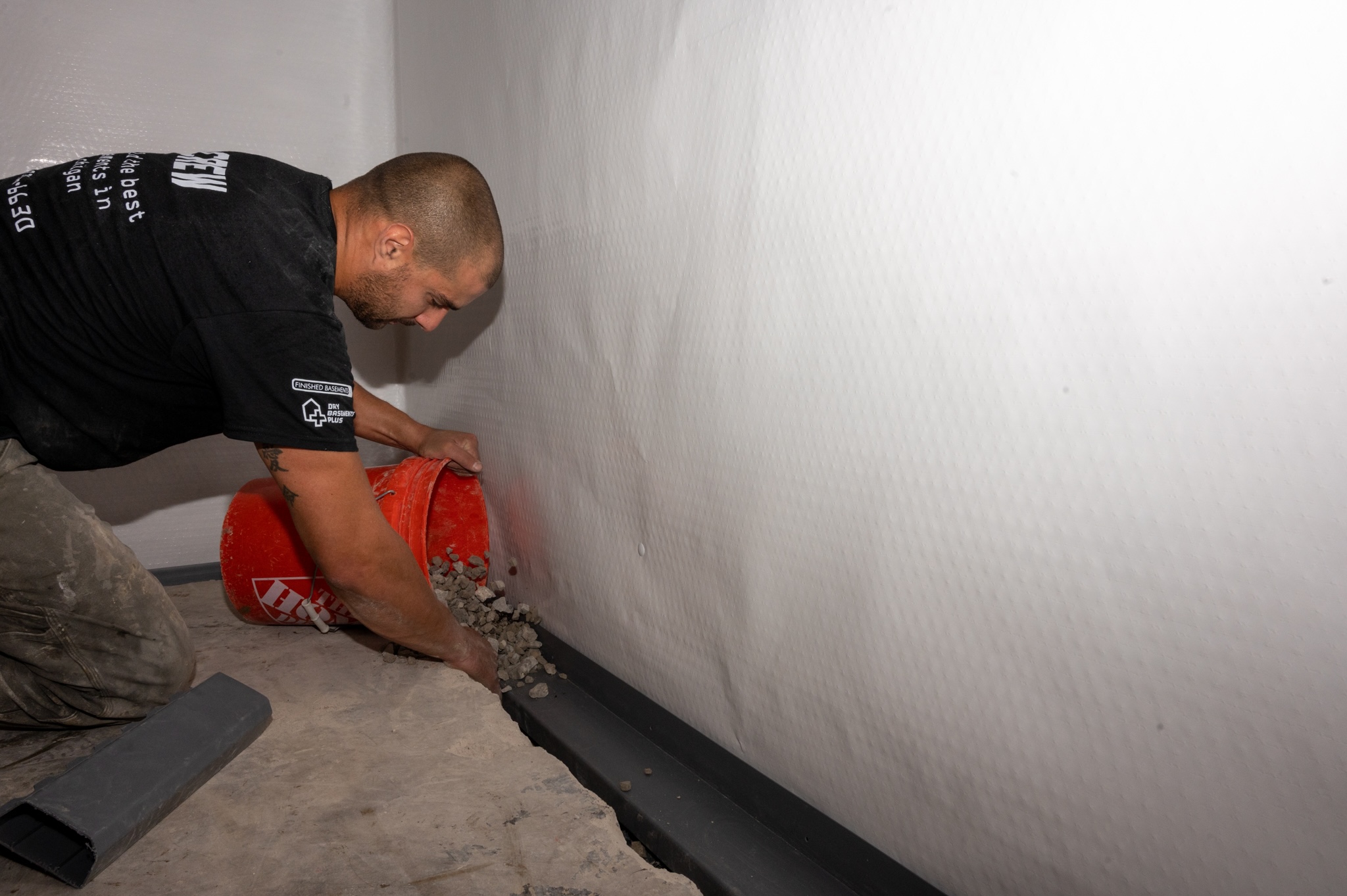
A drain tile system is installed along the interior perimeter of the basement, usually beneath the slab, and channels water to a sump pump, which then pushes it out and away from the house.
Think of it less as “sealing out” water and more as “redirecting” it. Water follows the path of least resistance. An interior system gives it an easy path, straight into the drain tile and out through the sump pump, instead of up through your slab or in through your walls.
Once water reaches the drain tile, it flows to a sump basin where the pump lives. When water hits a certain level, the sump pump discharges it through a line that carries it away from your foundation and out into the yard. The type of discharge line varies based on your city’s requirements, but either way it’s a small, contained dig (nothing close to the scale of exterior excavation). We always restore the area as best we can after the project is complete.
This work is done almost entirely from inside the basement, requires no heavy equipment in your yard, and can typically be completed in about two days.
See how the TripleSafe Sump Pump works
What Exterior Waterproofing Actually Does
Exterior waterproofing takes a different approach entirely. It requires excavating around your foundation, down to the footing, to expose the outside of the foundation walls. Once exposed, crews apply a waterproof membrane or coating and often install exterior drain tile to move water away before it ever reaches the wall.
In theory, this stops water from touching the foundation at all. In practice, it’s a major undertaking, excavation equipment on your property, disrupted landscaping, mature trees and shrubs potentially at risk and a timeline that depends heavily on weather. It’s also a much larger scope of work than most basement water problems actually call for.
Why Interior Is the Right Fit for Most Michigan Basements
Michigan’s clay-heavy soil holds water and shifts with our freeze-thaw cycles, which is a big part of why basements in Michigan deal with foundation issues in the first place. An interior drain tile and sump pump system is built specifically to manage that water as it moves toward your foundation, regardless of the season or how much the ground shifts outside.
This kind of water movement usually shows up the same way in home after home:
- Water stains on the walls, even old dried ones
- A musty smell that keeps coming back
- White, chalky efflorescence on the concrete
- Water pooling where the wall meets the floor
- A sump pump that runs constantly
Interior systems are easy to maintain, something an exterior system can’t offer because it is buried deep in the ground. You can flush an interior drain tile system to clear out the dirt, debris and iron ocher that cause failure, since it’s accessible from inside of your home.
The Cost Difference
Exterior waterproofing involves excavation equipment, landscaping restoration, hardscape removal and restoration expense quickly adding up in the range of $20,000 to $30,000. Then you need to prepare to spend money on the restoration of landscaping, decks and patios.
Interior systems have their own real cost, drain tile, a sump pump, and discharge line work all add up too, but it’s a more contained, faster, and less invasive process. A full-perimeter interior system with drain tile, a TripleSafe sump pump, vapor barrier, and battery backup typically runs between $10,000 and $20,000 depending on the size of your basement and what your specific setup needs. An in-home inspection is still the only way to know where your project falls in that range.
Financing is also available if you’d rather spread the cost out instead of paying all at once.
The Basements Plus Approach
Our Waterproofing, Crawlspace, and Foundation team focuses on interior waterproofing systems, drain tile, sump pump installation, foundation and crawlspace repair, and full encapsulation. We do not perform exterior excavation waterproofing. That’s a deliberate choice, not a limitation we’re working around. For the water issues we see in the vast majority of Michigan basements, an interior system solves the problem more efficiently, less invasively, and at a lower cost than digging up your yard would.
If your home does have a genuine structural or grading issue that calls for exterior work, we’ll tell you that directly during your inspection. Our goal is to give you an honest read on what’s actually happening in your basement so you can find the right contractor to fix the right issue.
Curious what installation actually looks like?
Not Sure Which Situation You Have?
The only way to know for certain is to have someone take a look. If you’re dealing with dampness, musty smells, or visible water in your basement, schedule a free inspection and we’ll walk you through exactly what’s causing it and what it will take to fix — no pressure, no guesswork.

Topics: